
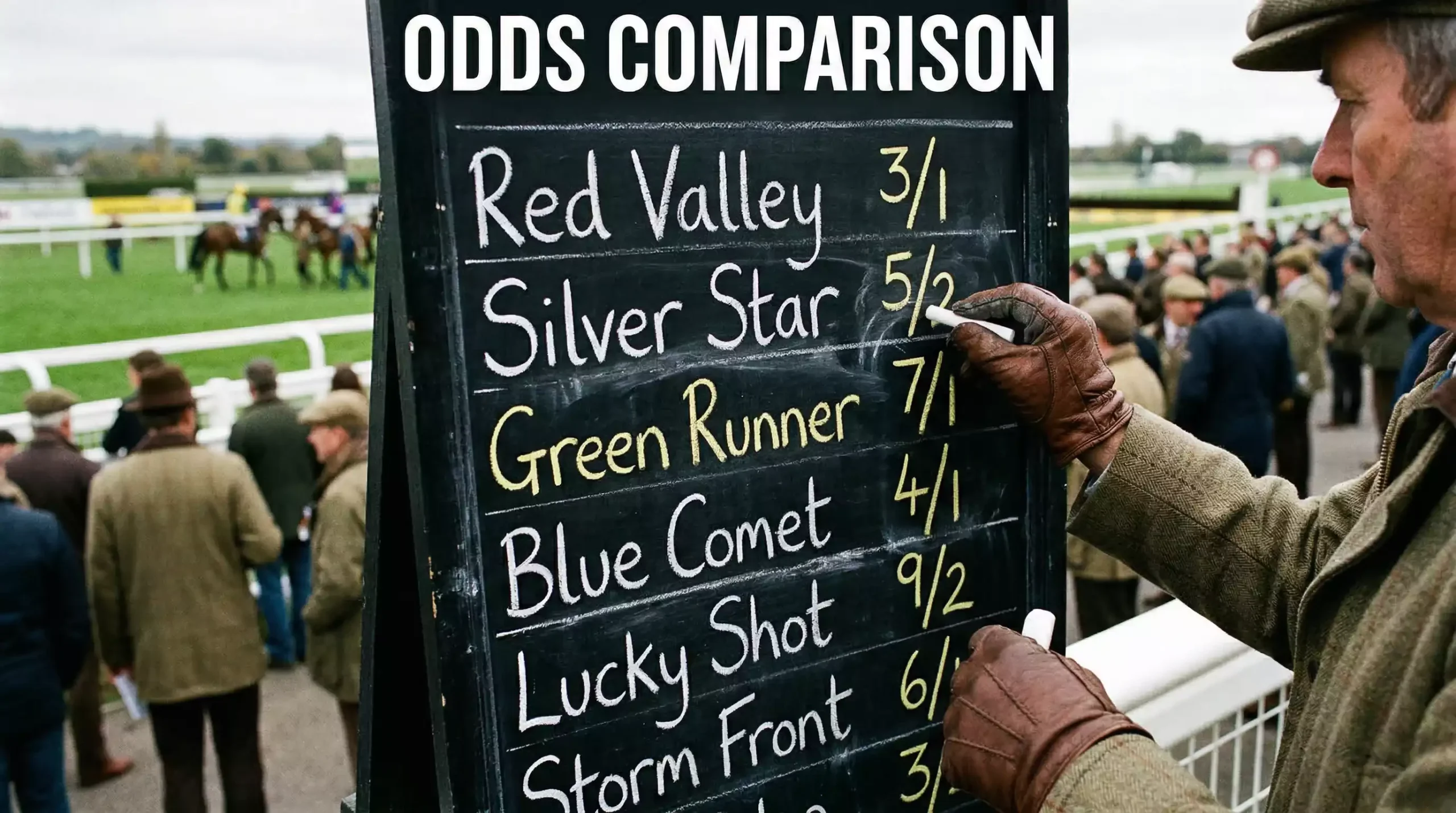
Horse racing odds comparison is the single most important habit a punter can develop, and it is also the one most punters neglect. The difference between 5/1 and 6/1 on the same horse in the same race is a 20 per cent increase in profit — free money, essentially, for the 30 seconds it takes to check a second bookmaker. Yet the majority of bettors place their bets with whichever app they last used, at whatever price happens to be on screen, without checking whether a better number is available elsewhere. Horse Racing Odds Comparison — More on this topic at horse racing bookmakers.
This is not a marginal issue. UK horse racing generated 766.7 million pounds in gross gambling yield from remote betting in the financial year ending March 2025 — the second-highest sport behind football. A significant share of that GGY exists because punters accept worse odds than they need to. The bookmaker margin is built into every price, but how wide that margin is varies enormously between operators, between race types, and between the fixed-odds market and the betting exchange. Understanding those differences is where value lives.
This guide explains what overround is and why it matters, compares bookmaker margins across different race types, breaks down the numbers on exchange versus fixed-odds betting, and shows how Best Odds Guaranteed can function as a value lever when used correctly. If you cannot see the margin, you cannot find the value. That is the principle behind everything that follows.
What Is Overround and Why It Matters
Overround is the bookmaker’s built-in margin, expressed as a percentage above 100 per cent. In a perfectly fair market with no margin, the implied probabilities of all runners in a race would sum to exactly 100 per cent. In practice, they always sum to more — typically between 110 and 130 per cent for horse racing — and that excess is the overround. It is the bookmaker’s theoretical profit margin before a single bet is settled.
Here is how to calculate it. Take an eight-runner race with the following fractional odds: 3/1, 4/1, 5/1, 7/1, 8/1, 10/1, 14/1, and 20/1. Convert each to implied probability: 25%, 20%, 16.7%, 12.5%, 11.1%, 9.1%, 6.7%, and 4.8%. Sum those probabilities: 105.9%. The overround is 5.9 per cent, meaning the bookmaker has built a theoretical edge of just under 6 per cent into the market. If the bookmaker were to take bets in exactly the proportions implied by the odds, they would expect to keep about 5.6 per cent of the total stakes regardless of which horse wins (5.9/105.9).
Why does this matter to you? Because overround is the hidden cost of every bet. A horse priced at 5/1 with a bookmaker running a 120 per cent book is not the same value as a horse priced at 5/1 with a bookmaker running a 110 per cent book — even though the headline odds are identical. The 120 per cent book means the prices across the entire field are compressed, which means every price is slightly lower than it should be in a fair market. The individual difference may be small — perhaps 5/1 versus 11/2 — but across hundreds of bets over a year, that cumulative margin is the difference between a profitable punter and a losing one.
The overround also tells you something about the race itself. Small-field races with well-fancied favourites tend to carry lower overrounds (closer to 110 per cent) because the market is more efficient and bookmakers compete harder on the headline price of the favourite. Large-field handicaps carry higher overrounds (120-130 per cent or more) because there are more prices to inflate and fewer punters checking each one individually. The worst overrounds appear in ante-post markets, where the uncertainty justifies — in the bookmaker’s view — margins that can reach extraordinary levels.
Checking the overround before you bet is not something most punters do, but it takes less than a minute with a calculator or an odds comparison site. If Bookmaker A is running a 115 per cent book on a race and Bookmaker B is running a 125 per cent book, Bookmaker A is systematically offering better value across the entire field. You do not even need to know which horse to back — the market-level comparison tells you which bookmaker to use.
There is a practical implication for staking, too. If you bet at a bookmaker with a consistently higher overround, you need a higher strike rate just to break even. A punter who backs winners at a true probability of 20 per cent (fair odds of 4/1) will lose money at a bookmaker pricing that horse at 3/1 (implied probability 25 per cent in a high-margin book) and break even — or profit — at a bookmaker pricing it at 7/2 (a tighter book). The difference between 3/1 and 7/2 is not dramatic on a single bet, but across 200 bets over a season it represents dozens of units of profit or loss. Overround is not an academic concept. It is the single biggest determinant of your long-term return.
Bookmaker Overround Comparison
The margin a bookmaker builds into horse racing odds is not fixed. It varies by operator, by race type, and by the time of day. Understanding the typical ranges gives you a framework for evaluating whether the price you are being offered is competitive or padded.
Across UK and Irish horse racing, typical bookmaker overrounds range from about 110 to 130 per cent. At the lower end, you find small-field Flat races — Group 1 contests with five or six runners where the form is well established and bookmakers compete aggressively on the headline price of the favourite. At the upper end, you find big-field handicaps with 20 or more runners, where each horse price can be inflated by a few ticks without any individual punter noticing the difference. The aggregate effect across 20 runners adds up to a much wider margin than in a six-runner race.
Ante-post markets for major festivals occupy a different universe entirely. The overround on the Grand National ante-post market can reach as high as 180 per cent — a level that would be considered predatory in any raceday market. That extreme margin reflects the non-runner risk (the bookmaker cannot lose on a horse that does not run, because the bet is forfeited) and the information asymmetry (the bookmaker knows more about likely runners months out than the average punter does). Ante-post markets on the Cheltenham Gold Cup or Champion Hurdle typically run between 140 and 160 per cent, which is lower than the National but still significantly wider than raceday.
On the raceday market itself, there are consistent patterns. The first show of prices in the morning — often called the early prices — tends to carry a wider margin than the Starting Price. Bookmakers open with a cautious book and adjust as money comes in. By the time the race starts, competition among operators has usually tightened the market. This is one reason why Best Odds Guaranteed is valuable: it lets you take an early price (which is sometimes bigger) while guaranteeing you the SP if it drifts even further in your favour.
There is also a clear hierarchy among operators. The betting exchanges, led by Betfair, consistently offer the tightest markets because there is no built-in bookmaker margin — the overround on exchange markets typically sits between 102 and 105 per cent, with the exchange taking a commission (usually 2 to 5 per cent) on winning bets instead. Among fixed-odds bookmakers, bet365, Paddy Power, and William Hill tend to be competitive on feature races, while some smaller operators run wider books, particularly on less prominent meetings.
The extra-places market is worth a specific mention. When bookmakers extend place terms on big handicaps — paying five or six places instead of four — they compensate by widening the margin on the place element of each-way bets. Analysis from MatchedBettingBlog suggests that margins on extra-places markets can reach as high as 50 per cent. That does not mean extra places are bad value — the additional place coverage can still be worth the wider margin, depending on the race — but it does mean you should not assume that an extra-places promotion is automatically a gift. The bookmaker is giving with one hand and taking with the other.
Exchange vs Fixed Odds: Numbers
The betting exchange — Betfair being the dominant platform — operates on a fundamentally different model to a traditional bookmaker. Instead of setting odds and accepting bets against them, the exchange matches punters on opposite sides of a bet. One person backs a horse to win; another lays it (bets against it winning). The exchange takes a commission on the net winnings of the winning side, typically between 2 and 5 per cent depending on the user’s activity level.
The result is consistently tighter odds. Where a bookmaker might offer 5/1 on a horse with a 120 per cent book, the exchange might show 5.5 (or 9/2 in fractional terms) on the same runner with a total market overround of 103 per cent. That difference — roughly 10 per cent on the individual price — is the cost of the bookmaker margin. Over time, backing at exchange odds rather than bookmaker odds produces a measurably higher return on investment, assuming you can find liquidity on your chosen market.
Liquidity is the critical qualifier. On feature races — the Champion Hurdle, the Gold Cup, the Grand National, Saturday afternoon handicaps at major tracks — the exchange market is deep enough that you can back at the displayed price without difficulty. Hundreds of thousands of pounds are matched, and the spread between the back and lay prices is narrow. On a Monday afternoon novice hurdle at a minor track, liquidity is thin. The back price might be 6.0 but only fifty pounds is available at that price, and the lay price might be 7.0 — a gap that represents poor value for anyone trying to trade. Flutter Entertainment, which owns Betfair, reported global revenue of $14 billion in 2024 across 13.9 million average monthly users, but the exchange is only one part of that portfolio, and liquidity varies enormously by market.
There is a subtlety that experienced exchange users understand and newcomers often miss. The commission you pay on an exchange winning bet reduces your effective odds. If you back at 6.0 (5/1) and pay 5 per cent commission on your winnings, your effective odds are 5.75 (approximately 19/4). That is still usually better than the bookmaker price, but the gap narrows. On short-priced selections — odds-on or evens — the exchange commission can actually make the bookmaker price competitive or even better, because the commission is a fixed percentage of the profit regardless of the odds.
When should you use the exchange, and when should you use a bookmaker? The exchange is superior for: backing at longer prices on feature races with good liquidity; laying horses (a tool that bookmakers do not offer at all); and trading positions during a race or in-play. The bookmaker is superior for: small-field races with thin exchange liquidity; each-way bets (exchanges do not offer a native each-way product — you would need to place separate back bets on the win and place markets); and any bet where Best Odds Guaranteed is available, because the BOG floor provides a safety net the exchange cannot match.
The practical approach for most punters is to use both. Check the exchange price on your selection before placing with a bookmaker. If the exchange offers 6.0 and the bookmaker offers 5/1, the bookmaker is competitive after commission. If the exchange offers 7.0 and the bookmaker offers 5/1, the bookmaker is taking a significantly larger margin on that runner, and you should either back on the exchange or find a bookmaker whose price is closer to the exchange level. Using the exchange as a benchmark — even if you ultimately bet with a bookmaker — is one of the most effective habits a punter can develop.
BOG as a Value Lever
Best Odds Guaranteed is one of the most powerful tools available to horse racing punters, and it is routinely undervalued. The mechanic is simple: if you take an early price on a horse and the Starting Price is higher, the bookmaker pays you at the better price. If the SP is lower, you keep the price you took. It is a one-way ratchet in the punter’s favour — a free option on upward price movement with no downside risk.
To understand why this matters, consider the context. Betting turnover per race across British horse racing fell by 8 per cent year on year in 2024/25, according to the HBLB Annual Report. That decline puts pressure on bookmakers to attract and retain bettors. BOG is one of the primary retention tools — a permanent promotion that rewards punters who bet early and creates a reason to stick with a bookmaker rather than switching to whichever operator offers the best price at the exact moment of betting.
The value of BOG depends on how much Starting Prices drift from the early prices. On horses that are supported in the market — money coming in, price shortening — BOG adds nothing, because the SP is lower than the price you took. On horses that drift — less money than expected, price lengthening — BOG gives you the benefit of the higher SP. Research on UK racing suggests that around 35 to 40 per cent of runners drift to a higher SP than their morning price. That means BOG triggers on a meaningful proportion of bets, and the average uplift when it does trigger is typically between half a point and two full points of odds.
There are practical considerations that limit BOG value. Most bookmakers cap BOG payouts — some at a maximum enhanced payout of 500 pounds, others at a maximum uplift of a certain number of odds points. A few bookmakers restrict BOG to races shown on ITV or feature meetings, excluding the smaller afternoon cards where drifts are more common. And some operators apply BOG only to bets placed after a certain time in the morning, which means very early ante-post-style wagers do not qualify.
Despite these caps, BOG remains the single most consistently valuable promotion in horse racing. Unlike free bets, which come with qualifying conditions and wagering requirements, BOG applies to every qualifying bet you place. It does not require you to do anything special — just take an early price on a race where BOG is offered. Over the course of a season, the cumulative effect of BOG upgrades adds up to a meaningful improvement in your overall return.
Grainne Hurst, CEO of the Betting and Gaming Council, warned that the upcoming tax changes could erode these kinds of punter benefits: “Odds will get worse, places will be shortened if the tax is increased on the products.” If higher operating costs lead bookmakers to tighten or restrict BOG terms, the current generous conditions may not last. Punters who take advantage of BOG now — particularly on feature races at major meetings — are exploiting a competitive dynamic that the regulatory and tax environment may eventually squeeze.
Practical Toolkit: Finding the Best Price
Finding the best price is a process, not a talent. It takes a few minutes per race and can be done from your phone. Here is the workflow that experienced punters follow, stripped of anything unnecessary.
Start with an odds comparison service. Oddschecker is the most widely used in the UK and shows prices from all major bookmakers side by side, updated in near-real time. For any given horse, you can see the best available price highlighted, and the difference between the best and worst price is often two or three points of odds — the difference between 7/1 and 5/1 on the same horse in the same race. That spread is the bookmaker’s inconsistency, and it is your opportunity.
Next, check the exchange. Open Betfair or Smarkets and look at the back price on your selection. This serves two purposes. First, it gives you a benchmark for whether the bookmaker prices are competitive. If the exchange back price is 8.0 and the best bookmaker is offering 6/1, the bookmaker is taking a significantly wider margin on that horse. If the exchange is at 7.0 and the bookmaker is at 6/1, the prices are closer, and after exchange commission the bookmaker might even be marginally better. Second, the exchange price reflects pure market opinion without any built-in margin, which makes it a more accurate indicator of the horse’s implied probability.
Then assess whether Best Odds Guaranteed is available. If you are betting early in the day and BOG is on offer, take the best available bookmaker price. If the price drifts, BOG catches the uplift. If it shortens, you locked in the higher number. This is the scenario where betting early has a structural advantage — BOG gives you a free call option on price movement.
Finally, consider enhanced odds promotions. Around major meetings — Cheltenham, the Grand National, Royal Ascot — bookmakers offer boosted prices on selected runners. These are marketing subsidies: the bookmaker accepts a loss on the enhanced price to attract new customers. If the enhanced price represents genuine value (and it often does, particularly on shorter-priced selections where the boost is meaningful), use it. But check the cap on the maximum stake, because enhanced odds are almost always limited to small bets — one or two pounds, occasionally five. See also Horse Racing Free Bets and Welcome Offers.
The entire process takes three to five minutes per race. Compare, benchmark, apply BOG, check for enhancements. That small time investment — repeated across every bet you place — is the most reliable edge available to the average punter. It does not require superior form knowledge, inside information, or mathematical genius. It requires discipline. If you cannot see the margin, you cannot find the value. This toolkit makes the margin visible.
