
Loading...
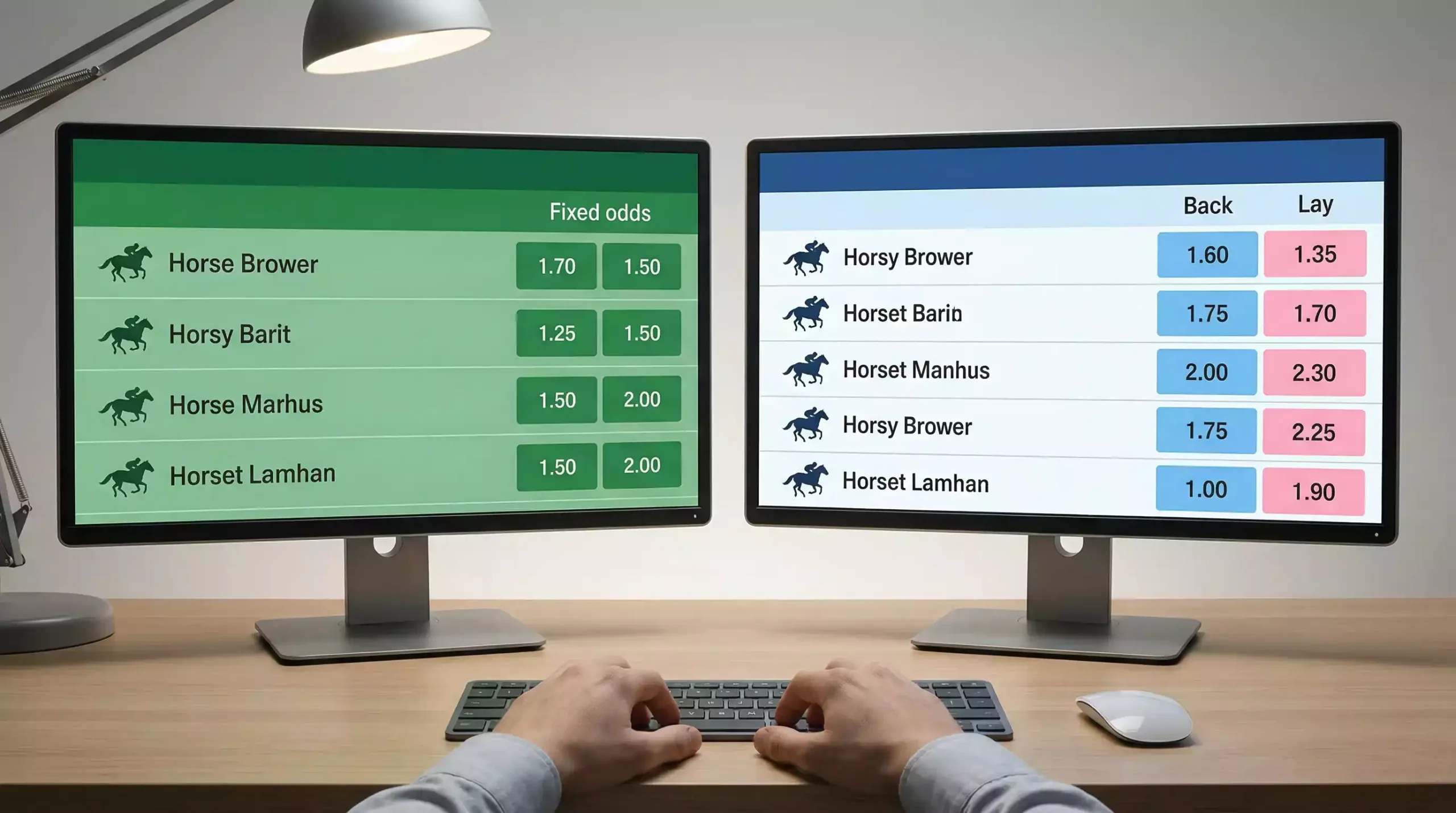
Betting exchange vs bookmaker is a question that every serious horse racing punter eventually confronts, usually after noticing that the odds on the exchange are consistently better than what the bookmaker offered. The exchange model — pioneered by Betfair and now part of Flutter Entertainment’s $14 billion global operation — works on a fundamentally different principle from a traditional bookmaker. Instead of the operator setting the odds and taking the opposite side of your bet, the exchange matches you with another punter. One person backs, another lays, and the exchange takes a commission on the winning side.
That structural difference has practical consequences for everything from the odds you receive to the bets you can place. The exchange takes a commission. The bookmaker takes a margin. Know the difference — and you’ll know when to use each.
How a Betting Exchange Works
A betting exchange is a platform where punters bet against each other rather than against a bookmaker. Every bet has two sides: a backer (who thinks the horse will win) and a layer (who thinks it won’t). The exchange matches these parties and holds the stakes until the race is settled.
Backing on an exchange is functionally identical to placing a bet with a bookmaker — you select a horse, choose your stake, and if it wins, you collect. The difference is in the odds. Because the exchange doesn’t set the prices, they’re determined by supply and demand among punters. On popular UK races with deep liquidity, exchange prices are almost always better than bookmaker prices because there’s no built-in margin — just the commission.
Laying is the distinctive feature that separates exchanges from everything else. When you lay a horse, you’re betting it won’t win. You effectively become the bookmaker for that bet. If the horse loses, you keep the backer’s stake minus commission. If it wins, you pay out the winnings. Laying opens an entire dimension of strategy that traditional bookmakers don’t offer: you can profit from a horse losing, trade positions during a race, or hedge an existing bet by laying after the price has moved in your favour.
The commission model varies between exchanges. Betfair’s standard commission is 5% on net winnings, though active users earn lower rates through a discount scheme. Smarkets charges 2%. Betdaq typically charges 2–5% depending on the market. Commission is charged only on the winning side — if you lose, you pay nothing beyond your lost stake. This contrasts sharply with a bookmaker, where the margin is embedded in the price on every bet you place, win or lose.
One mechanical detail worth noting: exchange odds are displayed in decimal format by default. A horse at 4.0 on the exchange is equivalent to 3/1 in fractional odds. The decimal format makes calculations cleaner, which matters for in-play trading where speed counts.
Exchange vs Bookmaker: Head to Head
The most important comparison is the effective margin you’re paying. A typical bookmaker overround on horse racing is 110–130%, meaning the bookmaker builds a 10–30% profit margin into its combined prices. On the exchange, the effective overround on popular races is typically 102–105%, sometimes lower on the biggest events. Over a season of regular betting, that difference translates directly into better returns. A punter getting 5/1 on the exchange when the bookmaker offers 9/2 collects more on every winning bet, and that gap compounds across hundreds of wagers.
Liquidity is where the bookmaker has the advantage. A traditional bookmaker guarantees a price on every horse in every race. The exchange only offers a price if someone is willing to take the other side. On a Saturday afternoon at Cheltenham, liquidity is deep and exchange prices are sharp. On a Tuesday evening at Wolverhampton, the exchange market might be thin — prices available only on the favourite, with the rest of the field either unpriced or offered at inflated odds with minimal stakes available. For everyday racing at smaller tracks, the bookmaker’s guaranteed market is a practical necessity.
Best Odds Guaranteed doesn’t exist on exchanges. When you back at 5.0 on Betfair and the SP is 7.0, you receive 5.0. There’s no mechanism to upgrade your price after the bet is placed. You could lay at a shorter price to lock in profit, which achieves a similar economic effect — but with more effort and exchange expertise required. BOG remains a genuine bookmaker advantage for punters who bet early in the day.
Free bets, welcome offers, and ongoing promotions are almost exclusively bookmaker territory. Exchanges offer few promotional incentives because their commission-based model doesn’t support loss-leader marketing. Account restrictions, however, are a significant factor in the opposite direction. Bookmakers routinely limit or close accounts that win consistently. Exchanges don’t, because the exchange profits from commission regardless of which punter wins. If you’re a profitable bettor restricted by bookmakers, the exchange is the one platform that doesn’t penalise your success.
When to Use Each
The practical answer isn’t one or the other — it’s both, deployed for what each does best.
Use the exchange for your core racing bets on popular races: Saturday features, festival meetings, big handicaps where liquidity runs deep. The better odds on these races translate directly into better returns. Use the exchange for laying — hedging an ante-post position, trading in-play, or backing against a horse you believe is overpriced. Use the exchange when your bookmaker accounts have been restricted due to winning.
Use the bookmaker for everyday racing where exchange liquidity is thin. A weekday all-weather card at Chelmsford won’t have deep exchange markets, and the bookmaker’s guaranteed prices are more practical. Use the bookmaker for BOG — if you habitually take early prices and the SP regularly drifts higher, that guarantee delivers value the exchange can’t match. Use the bookmaker for promotions: welcome offers, extra places, enhanced odds, accumulator bonuses. The promotional ecosystem exists exclusively on the bookmaker side.
Use both in combination for maximum effect. Check the exchange price before accepting the bookmaker’s odds. If the exchange offers 6.0 (5/1) and the bookmaker offers 9/2 with BOG, the bookmaker might be better if you expect drift. If the exchange offers 6.0 and the bookmaker offers 4/1 with no drift expected, the exchange wins easily. That comparison takes seconds and should become habitual for any punter serious about extracting value from horse racing.
Running accounts on both Betfair and a traditional bookmaker isn’t a luxury — for regular racing punters, it’s the baseline. The edge gained from choosing the better price on each individual bet compounds into a meaningful advantage over a full season.
Exchange or Bookmaker — Which Suits You?
Neither the exchange nor the bookmaker is categorically better for horse racing. The exchange offers superior odds on liquid races, freedom from account restrictions, and the ability to lay and trade. The bookmaker offers guaranteed markets on every race, BOG, promotions, and streaming. The punter who uses both — checking the exchange before every bet, using the bookmaker for promotions and thin markets, and shifting to the exchange for serious money on competitive races — maximises value over time. The difference between a punter who uses one and a punter who uses both is measurable over any reasonable sample. Make it a habit.