

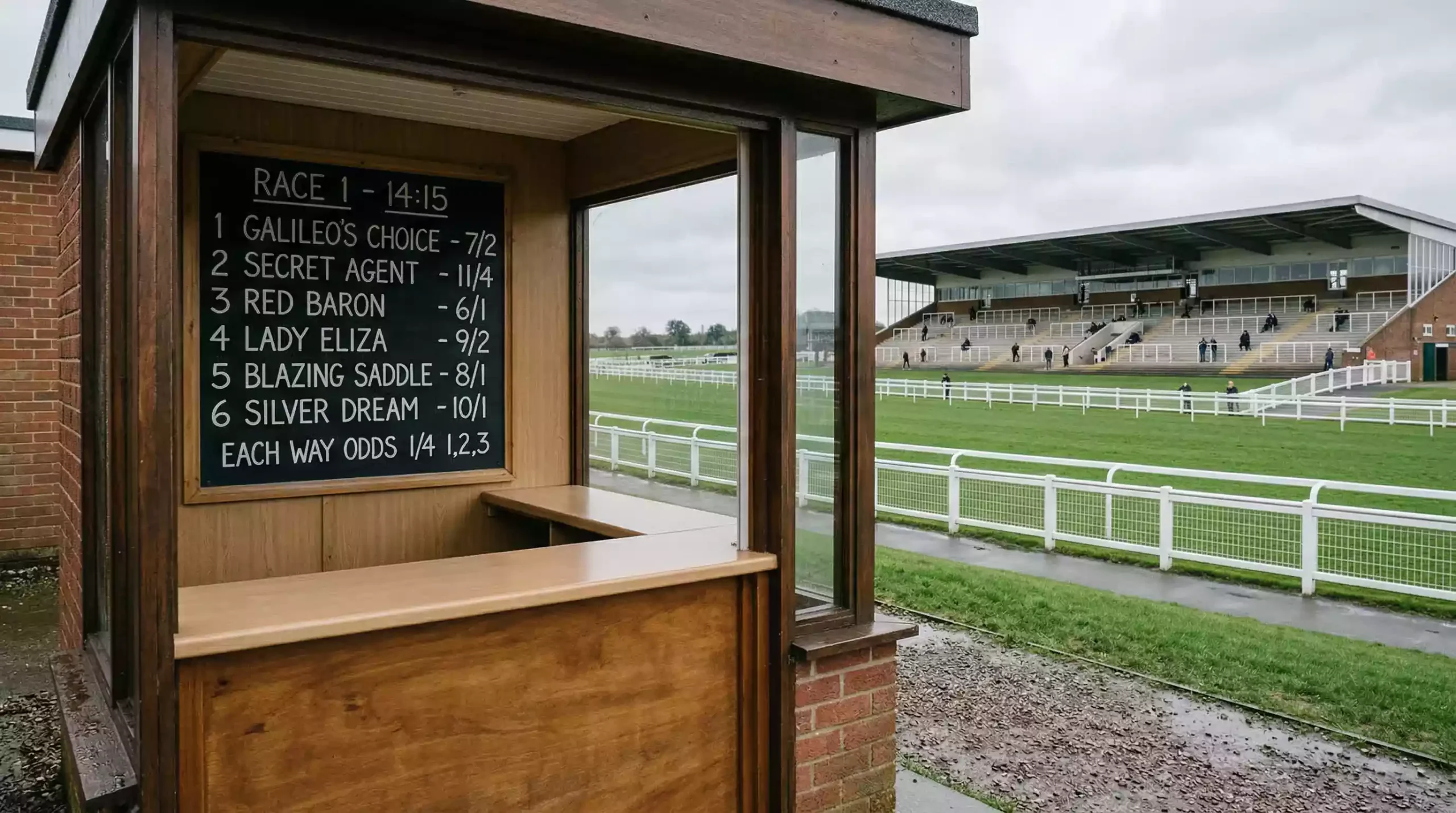
Horse racing betting turnover in the UK has been declining for several years, and the trend shows little sign of reversing. The numbers are unambiguous: total betting turnover on racing fell 6.8% in 2024 compared to the previous year, and was 16.5% below 2022 levels. That is not a blip. It is a structural shift in how much money flows through British racing’s betting markets, and it carries consequences for everything from prize money to field sizes to the odds bookmakers offer. Horse Racing Betting Turnover — More on this topic at horse racing bookmakers.
The causes are debated within the industry, but one factor dominates the conversation: affordability checks. These regulatory interventions, designed to protect vulnerable gamblers by limiting how much they can deposit and wager, have had a measurable impact on the volume of money bet on racing. Whether the checks are a necessary safeguard or a blunt instrument that punishes the majority for the risks of a minority depends on who you ask. What is not in dispute is that turnover is falling, and the sport is feeling the effects. Less money in — less prize money out.
The Decline in Numbers
The scale of the decline becomes clearer when you look at the data across multiple years. The BHA’s Racing Report for 2024 confirmed that total betting turnover on horse racing fell 6.8% year on year and 16.5% compared to 2022 — a cumulative drop that reflects not a single bad year but a sustained contraction.
The trend continued into 2025. The BHA’s Q3 report showed that total turnover for the first nine months of 2025 was 4.2% below 2024 and 12.8% below 2023. The rate of decline slowed slightly compared to the sharpest drops in 2023–2024, but the direction remained firmly downward.
Average turnover per race has fallen even more steeply than total turnover, because the number of races staged has remained broadly stable while the money flowing through each race has contracted. The HBLB’s Annual Report for 2024/25 showed that average turnover per race dropped 8% year on year, 15% compared to 2022/23, and 19% compared to 2021/22. Those percentages represent a market that is thinning out race by race — fewer pounds wagered per contest, which means less competitive markets, less liquidity for in-play betting, and a less attractive proposition for the bookmakers who price up each card.
The headline number — total turnover — matters to the industry because it feeds the betting levy that funds prize money and integrity services. But the per-race figure matters to punters because it affects the quality of the odds. Bookmakers who take less money on a race have less incentive to price it competitively, and the margins on low-turnover races tend to be wider than on popular fixtures. The decline is not just an industry problem. It shows up in the value available on your betslip.
Affordability Checks: The Main Driver
The BHA and most industry stakeholders point to affordability checks as the primary cause of the turnover decline. These checks, mandated by the Gambling Commission, require bookmakers to assess whether customers can afford their level of gambling. When a customer’s net losses exceed certain thresholds — typically over a rolling period of 90 days — the bookmaker must request evidence of income and financial circumstances before allowing the customer to continue betting at the same level.
The mechanism is straightforward, but its effects are broad. High-value customers — those who bet regularly at significant stakes — are the ones most frequently subjected to checks. These customers account for a disproportionate share of total turnover, so restricting their activity has an outsized impact on the overall figures. A single customer who bets £10,000 per week and is reduced to £2,000 per week after a check removes £8,000 of weekly turnover. Multiply that across thousands of customers across multiple operators, and the aggregate decline becomes substantial.
The checks also create friction that deters less extreme behaviour. Some punters who are asked for financial documents choose to stop betting with that operator rather than submit personal information. Others reduce their activity pre-emptively to avoid triggering the threshold. The deterrent effect is harder to quantify than the direct restriction, but industry surveys suggest it contributes meaningfully to the overall decline.
The counterargument — and it is a strong one — is that the checks are doing what they are designed to do: preventing people from gambling more than they can afford. If some of the lost turnover was money that customers could not genuinely afford to lose, then the decline represents a harm reduction success, not a market failure. The tension between protecting vulnerable gamblers and maintaining a healthy betting market is the central policy challenge facing UK racing, and it does not have a simple resolution.
Impact on Punters and the Sport
The turnover decline flows through racing’s economic model with predictable consequences. Lower turnover means lower bookmaker profits on racing, which means a lower levy yield, which means less money available for prize funds. The HBLB has maintained prize money support in the short term — increasing its allocation for 2026 — but the question of sustainability hangs over the sport. If turnover continues to fall, the levy will follow, and the prize money that attracts owners, trainers, and horses to compete will contract.
Field sizes are already under pressure. The number of horses in training fell to 21,728 in 2025, and the BHA’s modelling projects a further 6–7% decline in starts by 2027 if current trends continue. Smaller fields produce less competitive racing, which in turn generates less betting interest — a feedback loop that risks accelerating the decline rather than arresting it.
For individual punters, the effects are more subtle but still tangible. Thinner markets on lower-profile races mean wider margins and less competitive odds. The bookmakers who price up a Tuesday all-weather card with an expected handle of a few hundred thousand pounds will apply a wider overround than they would on a Saturday Ascot card where millions are at stake. As total turnover falls, more races fall into the low-handle category, and the average value available to punters deteriorates.
The promotional landscape is also affected. Bookmakers fund free bets, enhanced odds, and extra place offers from their marketing budgets, and those budgets are calibrated to expected revenue. Lower turnover means lower revenue, which means tighter promotional spending. The golden age of generous welcome offers and daily racing promotions may not continue indefinitely if the revenue base they depend on keeps shrinking. See also Black Market Gambling UK.
What Falling Turnover Means Going Forward
Horse racing betting turnover is falling, and the causes — principally affordability checks but also broader regulatory pressure and market shifts — are structural rather than cyclical. The consequences are real: pressure on prize money, thinner fields, wider margins on lower-profile races, and a promotional environment that may become less generous over time. For punters, the practical response is to concentrate betting activity on the races and markets where competition remains strong — Saturday features, festival meetings, big handicaps — and to compare odds more diligently as margins tighten. The sport is adapting, but the direction of travel is clear, and betting smartly matters more now than it did five years ago.
