Loading...
Best odds guaranteed is one of those phrases that gets thrown around on every bookmaker’s horse racing page, usually in bold letters next to a green tick. It sounds like a no-brainer — place your bet early, and if the starting price drifts higher, the bookmaker pays you the better price. Free money, right? Not quite. BOG is genuinely useful, but like any promotion, the value lives in the details: the caps, the timing windows, and the exceptions that most punters never bother to read.
The concept exists because horse racing odds move. You might back a horse at 8/1 in the morning, only to see it go off at 12/1 after the market shifts. Without BOG, you’re stuck at your original price. With it, the bookmaker bumps your payout to the SP. That’s a meaningful difference — and across a full season of racing, it compounds. But BOG isn’t charity. Bookmakers already build their margin into the odds they offer, with a typical overround of 110–130% on most races. BOG is a feature designed to keep you betting with them rather than shopping elsewhere. Understanding how it actually works — and where it stops working — is the difference between using it smartly and assuming it covers more than it does.
BOG Mechanics Step by Step
The mechanics of best odds guaranteed are straightforward on the surface but worth walking through properly, because the step where most punters lose out is one they never think about.
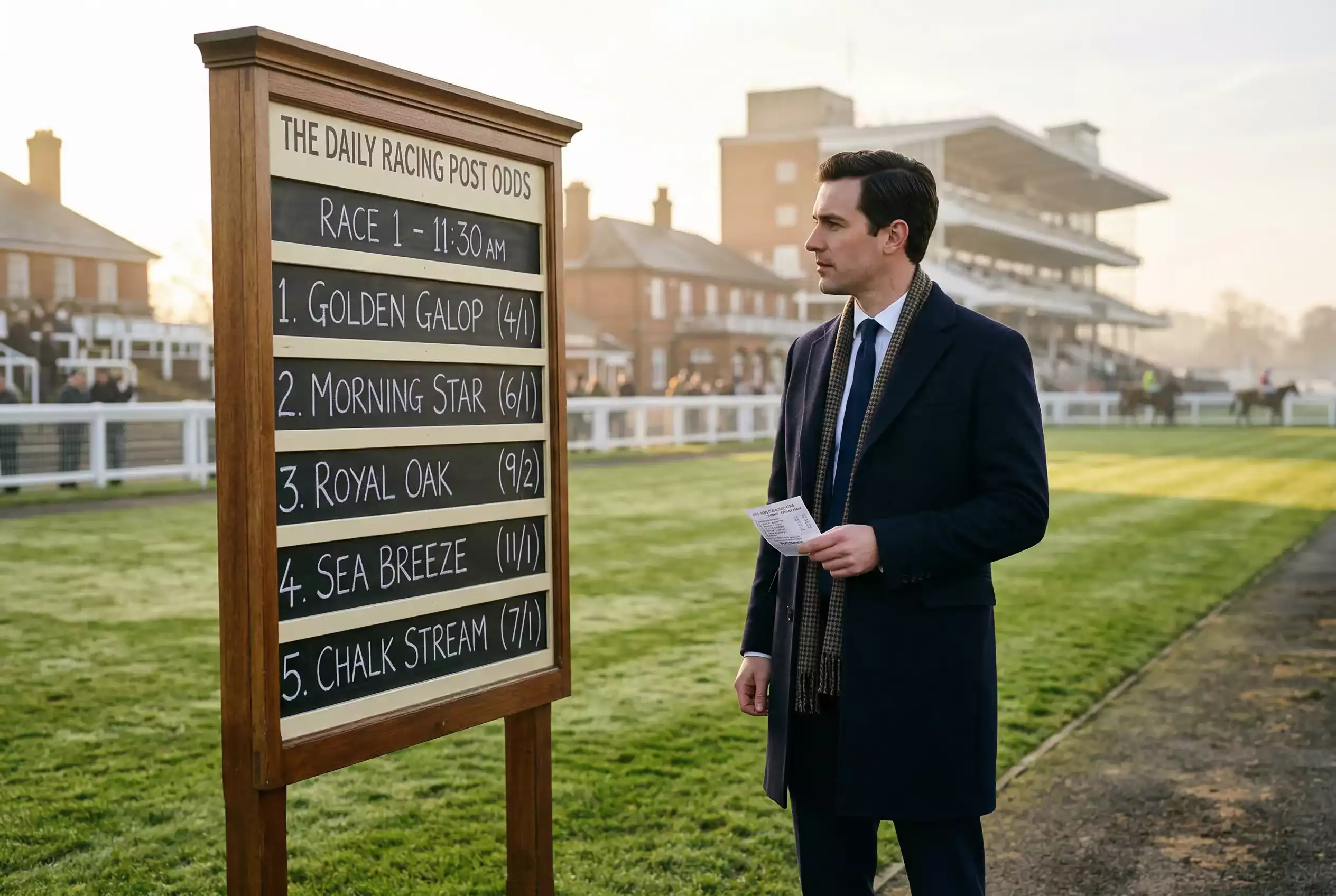
You open a race, find a horse you fancy, and place a win or each way bet at the price currently displayed — say, 6/1. Between the moment you place the bet and the off, the market does what markets do. Jockey bookings get confirmed, the going changes, money pours in on a rival, and your horse’s price drifts out to 9/1. Under BOG, if your horse wins (or places, in the each way component), the bookmaker settles at 9/1 rather than your original 6/1. You took the early price, got the higher SP, and paid nothing for the privilege.
The catch is what happens in reverse. If the horse’s price shortens — say from 6/1 down to 3/1 — you keep your original 6/1. BOG works in one direction only: it’s a floor, not a ceiling. The bookmaker guarantees the better of your price or the SP, which means the worst outcome is getting the odds you actually chose. That asymmetry is where the genuine value sits.
Remember, though, that the price you take in the morning is already below true probability — the bookmaker’s margin is baked into every price they offer. BOG doesn’t eliminate that margin; it cushions the impact when prices move in your favour. On a day where several of your selections drift at SP, that cushion can add a few percentage points of extra return across your bets. On a day where prices contract, BOG does nothing at all.
One detail that catches people out: BOG almost always applies only to bets placed at a fixed price, not to SP bets. If you select “SP” on your betslip, you’re requesting the starting price by definition — there’s no early price to compare against. The whole mechanism relies on there being two prices: the one you took and the one the horse goes off at.
BOG Comparison: Caps, Timing, Exceptions
Not all BOG promotions are created equal, and the differences between bookmakers matter more than most comparison sites bother to explain. Three variables separate a genuinely useful BOG policy from a marketing headline: the cap on enhanced winnings, the timing window, and the races that qualify.
Caps are the big one. Some bookmakers offer BOG with no upper limit — if your 20/1 shot drifts to 40/1 and wins, they pay 40/1 on whatever stake you placed. Others cap the enhanced payout at a fixed amount, commonly somewhere between £500 and £2,500. For a £5 each way punter, a £500 cap is irrelevant; you’d need to back a 50/1 winner at a decent stake to hit it. For anyone wagering £50 or more per race, caps become a real constraint. bet365 and William Hill have historically offered uncapped or high-cap BOG, while some smaller operators quietly set the ceiling much lower.
Timing is the second variable. Most bookmakers activate BOG from the point they price up a race — typically the morning of the race for UK and Irish fixtures. A few extend it to ante-post markets or early prices posted the evening before. Others restrict it to bets placed within a certain window, such as from 9am on the day of the race. If you habitually bet the night before, check whether your bookmaker’s BOG actually covers those bets. Paddy Power and bet365 tend to be generous on timing; smaller operators sometimes limit BOG to bets placed after final declarations.
Then there are the exceptions. BOG almost universally covers UK and Irish racing. International racing — France, Australia, the United States — is usually excluded. Some bookmakers exclude specific meeting types: all-weather fixtures at lower-tier tracks, or betting-without-the-favourite markets. A few exclude enhanced odds or price boost selections from BOG entirely, which is worth knowing if you tend to combine promotions.
The average betting turnover per race has dropped 8% year on year according to the HBLB Annual Report 2024/25, part of a longer decline that has squeezed bookmaker margins on racing. That pressure shows up in how aggressively operators manage BOG terms. What was a blanket, uncapped offer five years ago is increasingly hedged with conditions. Reading the small print isn’t paranoia — it’s due diligence.
When BOG Saves You Money (and When It Doesn’t)
BOG delivers its best value in a specific set of circumstances. The ideal scenario: you back a horse early in the day at a decent price, the market moves against it (other horses attract support, or a piece of negative news surfaces about a rival that reshuffles the market), and your selection drifts significantly before going off at a much bigger price — then wins. In a competitive handicap with 16 runners, that kind of drift is common. SP can move two, three, even five points above the morning price without anything dramatic happening. BOG pockets you the difference every time.
The scenario where BOG does very little: short-priced favourites in small fields. A 2/1 shot in a five-runner novice chase rarely drifts far enough for BOG to matter. If it goes from 2/1 to 5/2, the BOG enhancement on a £10 bet is £5. Welcome, but not life-changing. BOG also contributes nothing when your horse’s price shortens — and on days dominated by well-backed favourites, that happens more often than not.
There’s a broader context here too. Gráinne Hurst, CEO of the Betting and Gaming Council, has warned that odds will get worse and place terms shortened as tax pressures increase, with customers likely migrating to unregulated operators where protections like BOG simply don’t exist. In that environment, BOG becomes one of the few tools that can partially offset tightening margins. It won’t turn a bad price into a good one, but on the days where drift works in your favour, it ensures you’re not leaving money on the table.
The practical takeaway is simple. If you bet early and regularly — morning prices on UK and Irish racing, across a mix of fields — BOG will save you money over a season. Not every day, not on every bet, but consistently enough to matter. If you only bet at SP or stick to short-priced favourites, BOG is largely decorative. And if your bookmaker caps the enhancement at £500 but you’re wagering at levels where that ceiling bites, it’s time to compare policies rather than assuming they’re all the same.
Is BOG Worth It?
BOG is free insurance — but read the policy. The principle is sound and the value is real, especially for punters who take early prices on competitive UK and Irish races. But the gap between the best and worst BOG policies in the market is wider than most people realise. Uncapped BOG with generous timing from the morning price-up is a meaningfully different product from a capped offer that only kicks in after 9am and excludes all-weather cards.
Before you settle on a bookmaker for your racing, check three things: whether there’s a cap on the BOG payout, when the offer starts (morning price-up or later), and which meetings are included. Those three details determine whether BOG is a genuine edge or just another line of promotional copy. The best approach is to hold accounts with two or three bookmakers whose BOG terms suit your betting style, and compare prices before placing. That combination — price shopping plus BOG — is where the real value sits.