
Loading...
How to read a horse racing form guide is one of those things that separates punters who pick horses from punters who study them. The form guide — whether printed in the Racing Post, displayed on a bookmaker’s racecard, or scrolled through on an app — contains everything you need to assess a horse’s chances. The problem is that it presents that information in a dense, coded format that looks like an encrypted telegram if you don’t know what you’re looking at.
The good news is that the code isn’t complicated once you crack it. A string of numbers and letters next to a horse’s name tells you where it finished in its recent races, what surface it ran on, whether it won, and how it handled various conditions. Combine that with the trainer and jockey data, the going, and the course characteristics, and you’ve got a picture that’s far more useful than any tip column or gut feeling. The form book tells a story — and this guide will teach you to read it.
Anatomy of a Racecard
A standard racecard — the page or screen that lists every runner in a race — packs a lot of information into a tight space. Understanding the layout is the first step. Here’s what you’ll typically find for each horse.
The horse’s name sits at the top, often alongside its age, sex, and colour. A five-year-old bay gelding might appear as “5 b g” — five years old, bay-coloured, gelding. Below or beside the name, you’ll see the trainer and jockey. The trainer’s name matters more than many casual punters realise. Certain trainers have strong records at specific courses or in specific race types, and trainer form over the past 14 days is a useful quick indicator of whether a yard is in good shape.
The weight the horse carries is listed — expressed in stones and pounds for UK racing. In a handicap, the weight is assigned by the official handicapper based on the horse’s rating: better-rated horses carry more, weaker ones carry less. In a conditions or Group race, weights are set by the race conditions rather than the handicapper. Either way, the weight tells you how much the horse is being asked to carry relative to its rivals, and a difference of a few pounds can influence the outcome over longer distances.
You’ll also see the draw — the stall number in flat races. On certain courses, particularly tight tracks with sharp turns, a low or high draw can be a significant advantage. Ascot on soft ground, for example, tends to favour higher draws in sprint races. Chester, with its tight left-handed turns, often favours low draws. On the Jumps, there’s no draw because horses line up at a starting tape rather than stalls. The official rating (OR) is the BHA’s assessment of the horse’s ability, expressed as a number. Higher is better. A horse rated 105 is significantly more capable than one rated 75, though the handicap system is designed to equalise their chances by adjusting the weights they carry.
Finally, racecards often display the price — the current odds offered by bookmakers — and may include indicators like the number of days since the horse last ran, any headgear worn (blinkers, visors, cheekpieces), and whether the horse has won at the course and distance before, often abbreviated as “C&D.”
Form Figures Decoded
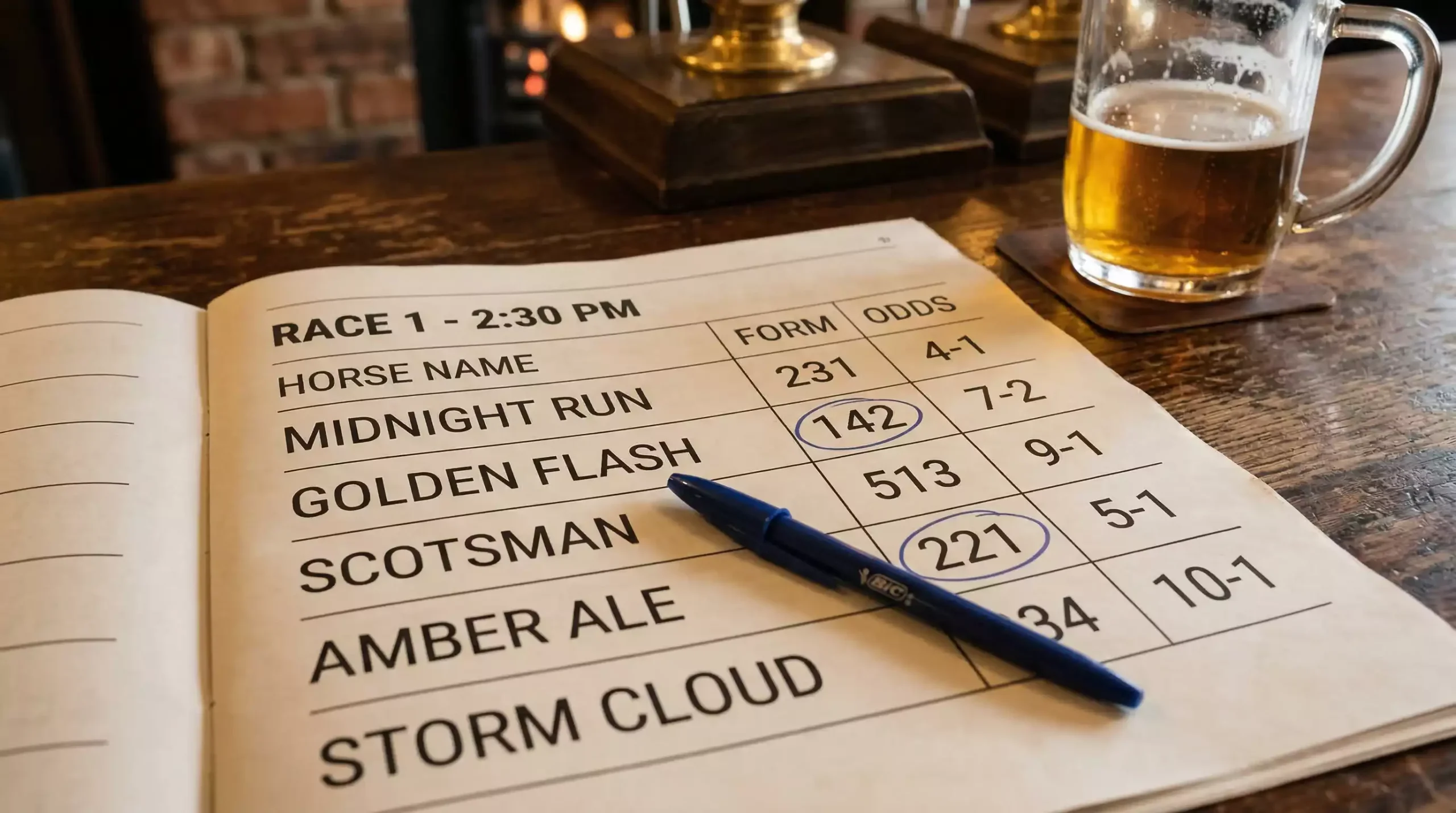
The form figures are the most important piece of shorthand on any racecard. They appear as a string of numbers and symbols — something like “2131-45” or “F0P82” — and each character represents a recent run.
Numbers show finishing positions. A “1” means the horse won. A “2” means it finished second, a “3” third, and so on. A “0” means the horse finished outside the top nine — effectively tailed off. The most recent run is always on the right. So a form string of “3121” means the horse won its last race, finished second before that, won the one before that, and finished third in the race before that. That’s strong form.
Letters carry specific meanings. “F” means the horse fell — relevant in jump racing, where falls are a risk factor. “U” means the horse unseated its rider, often at a fence or hurdle. “P” means it was pulled up, which typically indicates the horse was struggling and the jockey chose not to continue. “R” means it refused — usually at a fence. “B” means it was brought down by another horse’s fall.
A hyphen or slash in the form string indicates a break between seasons. “2131-45” tells you the horse has two runs this season (finishing fourth and fifth) and had a previous campaign where it showed much better form. That seasonal break is worth noting: a horse returning from a layoff may need a run or two to find its rhythm, and a drop in form after a break isn’t necessarily a sign of decline.
The total number of horses in training across Britain fell to 21,728 in 2025 — a decrease of 2.3% from the previous year, according to the BHA’s 2025 Racing Report. That shrinkage means field sizes are also under pressure, and reading form accurately becomes even more important when smaller fields produce fewer competitive races.
Key Indicators: Going, Trainer, Jockey
Form figures tell you what happened. The key indicators tell you why — and whether the same result is likely to happen again under today’s conditions.
The going — the state of the ground — is arguably the single most important variable in horse racing. UK going descriptions range from “heavy” (very soft, testing ground) through “soft,” “good to soft,” “good,” “good to firm,” and “firm” (dry, fast ground). Some horses are specialists on soft ground, relishing the extra stamina required. Others have light, quick actions that suit firm going. A horse with strong form on good to soft ground being asked to run on firm for the first time is an unknown quantity, and the form book should be read with that context in mind. Look for a lowercase “s” or “g” next to form figures in detailed guides — these indicate the going on the day the horse ran.
Trainer form is underused by many punters. A trainer whose horses have been winning at a 20% strike rate over the past fortnight is, in practical terms, having a hot streak — the horses are well, the preparation is right, and the selections are sharp. A trainer running at 3% over the same period is struggling. These stats are readily available on most racing websites and apps. Jockey bookings carry similar weight. When a top jockey is booked for an unfancied horse, it can signal that the connections (the people closest to the horse) expect a good run. It’s not infallible, but patterns in jockey bookings are one of the market’s softer signals.
Course and distance form — whether the horse has previously won or placed at today’s track and over today’s trip — is a concrete, measurable indicator. Average field sizes on the Flat dropped to 8.90 runners in 2025, while National Hunt fields fell to 7.84. In smaller fields, course specialists often outperform their ratings because they handle the unique characteristics of a track — its cambers, undulations, and turns — better than rivals who are running there for the first time.
Putting It Together: A Worked Example
Theory is useful, but let’s apply it. Imagine you’re looking at a racecard for a Class 3 handicap hurdle over two miles and four furlongs at Cheltenham on good to soft ground. One of the runners shows the following: form 2131-4, rated OR 132, trained by a yard running at 18% over the past 14 days, ridden by a conditional jockey claiming a 5lb allowance. The horse has a “C&D” marker — it’s won at Cheltenham over this distance before.
Here’s how to read that. The form figures show a horse that was winning before a seasonal break and returned with a slightly disappointing fourth on its reappearance. That’s typical — horses often need their first run back to blow away the cobwebs. The OR of 132 tells you this is a decent performer, comfortably above average for this class. The trainer’s 18% strike rate suggests the yard is ticking over nicely. The conditional jockey’s 5lb claim means the horse effectively carries less weight than its rating suggests, which is a tangible advantage in a handicap. And the course and distance win confirms it handles Cheltenham’s undulating track and the stamina test of two and a half miles.
None of this guarantees the horse will win. But it gives you a layered, evidence-based picture that’s far more reliable than a tip or a hunch. You can assess whether the price the bookmaker offers reflects the horse’s genuine chance — and that’s where form reading becomes not just an academic exercise but a tool for finding value. If the horse is priced at 10/1 but your form assessment suggests it should be closer to 6/1, that’s a potential bet. If it’s priced at 5/2 and your form assessment agrees, the value isn’t there.
The form book won’t make you right every time. But it will make you wrong for the right reasons, and over a season of racing, that discipline is what separates punters who break even from punters who don’t.