

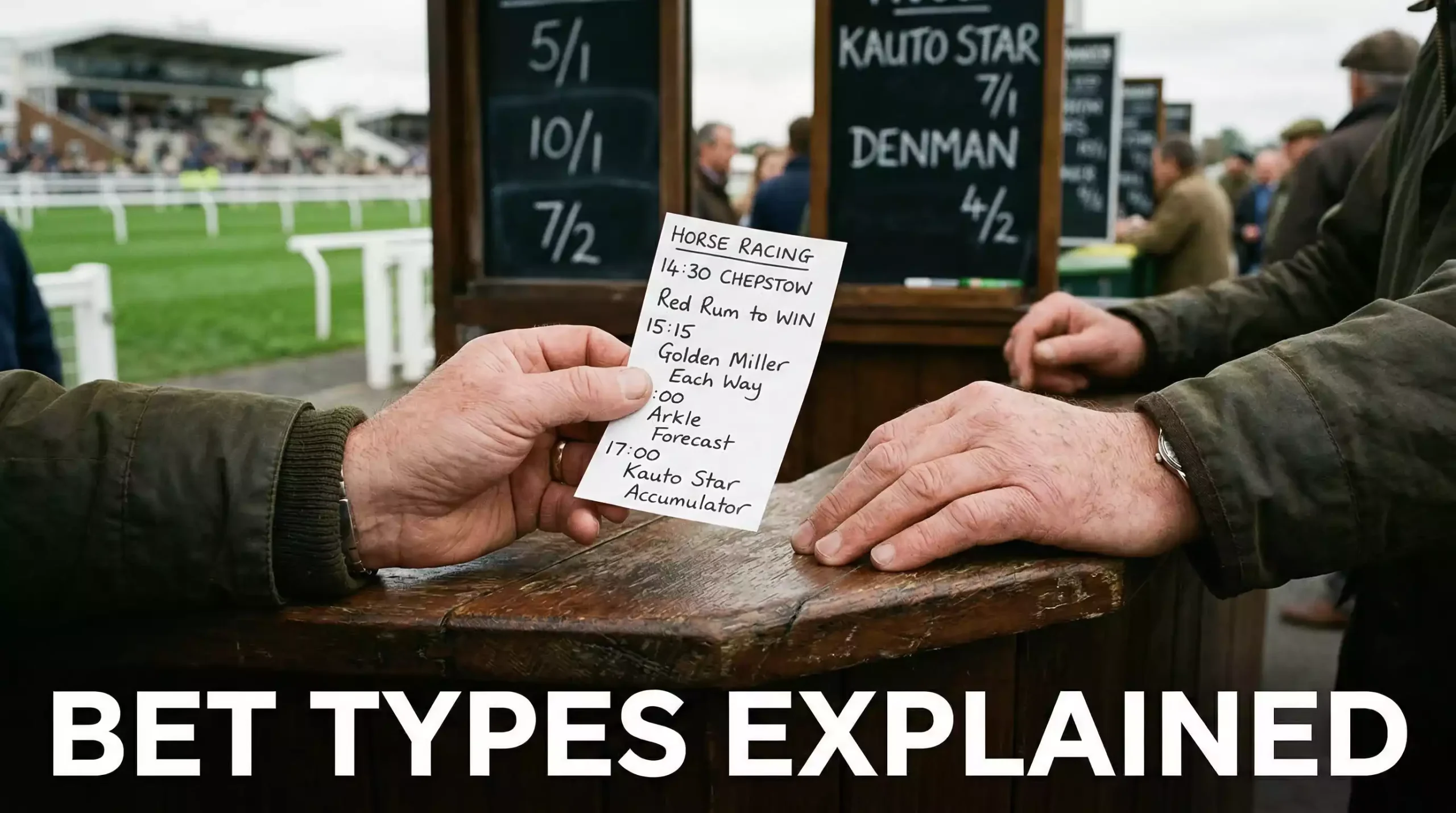
Each way betting horse racing explained in plain terms — that is the search most punters make right before they realise the subject goes deeper than they expected. Horse racing offers more bet types than any other sport, from the straightforward win bet to the labyrinthine Lucky 15, and understanding the mechanics of each one is the difference between making informed decisions and throwing money at numbers you do not fully grasp. Horse Racing Bet Types Explained — More on this topic at horse racing bookmakers.
The Gambling Survey for Great Britain, published by the UK Gambling Commission, found that 10.3 per cent of UK adults participated in sports and horse racing betting online or via apps — roughly 5.5 million people placing bets through their phones and laptops. A significant proportion of that activity happens on horse racing, and yet the bet types available on a single race can number in the dozens. Win, place, each way, forecast, tricast, accumulator, Trixie, Patent, Yankee, Lucky 15, Lucky 31 — the menu is extensive, and each option carries its own mathematics, its own risk profile, and its own relationship to the bookmaker’s margin.
This guide works through all of them, from the simplest to the most complex, with real calculations rather than vague descriptions. Know the maths before you place the bet. That is not a slogan — it is the only sustainable approach to betting on horses.
Single Bets: Win, Place, Each Way
Win Bets
A win bet is the most straightforward wager in racing. You back a horse to finish first. If it wins, you collect your stake multiplied by the odds. If it finishes anywhere else — second, third, last — you lose your stake. The simplicity is the appeal, but simplicity does not mean there is nothing to understand.
Every set of odds offered by a bookmaker includes a built-in margin known as the overround. According to analysis from Top10BettingSites, a typical bookmaker overround on a horse racing market sits between 110 and 130 per cent. An overround of 100 per cent would represent a perfectly fair market — the sum of all implied probabilities adding up to exactly one. At 120 per cent, the bookmaker has a 20 per cent theoretical edge built into the prices. When you place a win bet at 4/1, the true probability implied by that price is 20 per cent, but the bookmaker has priced it as if the probability is slightly higher. That gap is how the bookmaker makes money, and it applies to every single bet you place.
None of this means win bets are bad value. In races with competitive fields and strong market liquidity — feature races at major meetings, Saturday afternoon cards — the overround tends to be tighter, sometimes dropping below 115 per cent. In small fields of four or five runners, the overround can be even lower. The key is awareness: know that the odds you see are not the true probability, and factor the margin into your assessment of value.
Place Bets
A place bet pays out if your horse finishes in a specified number of positions, regardless of whether it wins. The number of places paid depends on the size of the field. In races with five to seven runners, bookmakers typically pay two places. In fields of eight or more, three places are paid. In handicaps with 16 or more runners, four places is standard, though some bookmakers extend this further for specific events.
Place bets carry lower odds than win bets because the probability of a horse finishing in the top three is obviously higher than the probability of it winning outright. A horse at 10/1 to win might be around 3/1 or 7/2 for a place, depending on the field size and the bookmaker’s place terms. Place betting is most useful when you fancy a horse to run well but lack confidence that it will win — a common scenario in big-field handicaps where any one of eight or ten horses could take the race.
Each Way Bets
An each-way bet is two bets in one: a win bet and a place bet, placed simultaneously on the same horse at the same stake. If you bet £10 each way, your total outlay is £20 — £10 on the win and £10 on the place. The win part pays at full odds if the horse wins. The place part pays at a fraction of the full odds — typically one-quarter in fields of five to seven runners, and one-fifth in fields of eight or more — if the horse finishes in a paying position.
The maths: if you back a horse each way at 20/1 in a 12-runner race (one-fifth odds for a place), your win bet returns £210 (£200 profit plus £10 stake) if it wins, and your place bet returns £50 (£40 profit plus £10 stake). Total return on a winner: £260 from a £20 outlay. If the horse finishes second or third but does not win, only the place part pays: £50 return from your £20 outlay, giving you a £30 profit despite the horse not winning. If the horse finishes outside the places, you lose the full £20.
Each way is the bread and butter of horse racing betting, and for good reason. In big-field races — handicaps with 16 or more runners — the place element provides a safety net that makes longer-priced selections viable. Backing a horse at 25/1 in a 20-runner handicap each way gives you a realistic chance of a return even if the horse just runs into a place, because the one-fifth odds on the place portion still delivers a healthy profit relative to your stake.
Where each-way betting gets more nuanced is with dead heats and non-runners. A dead heat for a place position means your place bet is settled at half the odds — so a place return at 5/1 becomes 5/2 in a dead heat. This is a common scenario in photo finishes for the minor places. Non-runners after you have placed your bet trigger a Rule 4 deduction, which reduces your payout by a percentage based on the odds of the withdrawn horse. Both of these scenarios are covered in the special rules section below.
Multiple Bets: Doubles, Trebles, Accumulators
A double is a single bet that combines two selections. Both must win for the bet to pay out. Your returns from the first winner roll over as the stake on the second, which means the odds multiply. A £10 double on two horses at 3/1 and 5/1 returns £240 if both win: £10 at 3/1 gives £40, and that £40 at 5/1 gives £240. The same logic applies to trebles (three selections) and four-folds and beyond.
An accumulator — or acca — is a multiple bet with four or more selections. The cumulative odds grow rapidly with each additional leg: a five-fold accumulator on selections at 2/1, 3/1, 4/1, 5/1 and 6/1 has combined odds of 839/1 from a £1 stake. The payout potential is spectacular, which is precisely why accumulators are so popular and precisely why bookmakers love them. The probability of hitting a five-fold at those prices is roughly 0.12 per cent — less than one in eight hundred. The bookmaker’s margin compounds with each additional leg, because the overround on each individual selection stacks multiplicatively across the accumulator.
This compounding effect is the critical point that accumulator players need to understand. If the bookmaker’s overround on each individual race is 120 per cent, the effective overround on a five-fold accumulator is not 120 per cent — it is closer to 1.2 to the power of five, which is approximately 249 per cent. The house edge does not simply add up; it multiplies. That mathematical reality is why bookmakers actively promote accumulators with bonus offers: they make more money per pound staked on multiples than on singles.
Bookmaker accumulator bonuses — typically adding 5 to 10 per cent to winnings per additional leg — partially offset this compounding margin, but they rarely eliminate it entirely. A 10 per cent bonus on a five-fold adds value, but the underlying margin has already compounded to a level where the bonus is more of a marketing gesture than a market correction. This does not mean accumulators are never worth placing. It means they should be treated as high-risk, high-reward bets where the entertainment value is part of the equation, not purely as a value-seeking strategy.
Each-way accumulators follow the same principle but with both win and place elements. Each leg of the accumulator has a win and a place component, and the place parts accumulate separately. If one horse wins and another places but does not win, you lose the win accumulator but may still collect on the place accumulator. The returns are smaller, but the probability of getting something back is higher — which makes each-way accumulators a more forgiving format for punters who want the excitement of multiples without the all-or-nothing risk of a win-only acca.
One margin trap to watch in each-way accumulators involves extra-places markets. When bookmakers extend place terms on big handicaps — paying five or six places instead of four — they widen the margin on the place element to compensate. Analysis from Top10BettingSites and MatchedBettingBlog indicates that margins on extra-places markets can reach as high as 50 per cent. That does not automatically make them poor value — the additional place coverage often justifies the cost — but stacking inflated place margins across multiple legs of an each-way accumulator compounds the house edge further than most punters realise.
Full Cover Bets: Trixie, Patent, Yankee, Lucky 15
Full cover bets take the concept of multiples and expand it to cover every possible combination of your selections. Rather than backing a single accumulator that requires all horses to win, a full cover bet includes doubles, trebles and — in some cases — singles as well. This means you can collect a return even if not every selection wins.
A Trixie covers three selections with four bets: three doubles and one treble. You need at least two of your three picks to win in order to get a return. A Patent is the same three selections but with seven bets: three singles, three doubles, and one treble. Because the Patent includes singles, you can collect a return even if only one of your three picks wins. The cost, naturally, is higher — seven bets at your unit stake versus four.
A Yankee covers four selections with 11 bets: six doubles, four trebles and one four-fold. No singles are included, so you need at least two winners to see any return. A Lucky 15 covers the same four selections with 15 bets: four singles, six doubles, four trebles and one four-fold. The Lucky 15 is arguably the most popular full cover bet in horse racing, and for good reason — the inclusion of singles means that even a single winner produces a return, and most bookmakers offer consolation bonuses on Lucky 15 bets.
Those consolation bonuses are what make Lucky 15s particularly attractive for racing. Betfred, for instance, has traditionally offered double odds on a Lucky 15 if only one of your four selections wins, and a 10 per cent bonus across the board if all four win. Other bookmakers offer similar structures with varying terms. The consolation bonus turns the Lucky 15 from a pure gambling proposition into something closer to a structured bet with downside protection.
The appeal of the Lucky 15 for casual bettors is substantial. Data from the Grand National illustrates the scale of low-stakes participation — approximately half of all bets on the race are placed at stakes of £5 or less. That is the natural territory of a Lucky 15 at £1 per line. A £15 total stake gives you four singles, six doubles, four trebles and one four-fold, with the consolation bonus providing a floor under your worst-case outcome. For a Saturday afternoon card where you fancy four horses at decent prices, the Lucky 15 structure is hard to beat for entertainment value per pound spent.
Beyond Lucky 15, the same principle extends to larger selections. A Lucky 31 covers five selections with 31 bets. A Lucky 63 covers six selections with 63 bets. The cost scales rapidly, and the probability of all selections winning diminishes with each additional pick. For most punters, the Lucky 15 is the sweet spot — enough coverage to protect against a bad day, but not so many bets that the total stake becomes difficult to justify.
Forecast and Tricast
A forecast requires you to predict the first two finishers in the correct order. A reverse forecast covers both possible permutations — horse A first and horse B second, or horse B first and horse A second — and costs twice the unit stake. A computer straight forecast, often abbreviated to CSF, is settled at a dividend calculated by a formula based on the starting prices, rather than at fixed odds taken at the time of the bet.
Forecasts produce their best value in races where the finishing order is less predictable than the identity of the placed horses. A race where two horses dominate the market at 2/1 and 3/1 might offer a CSF dividend of 8/1 or 10/1 for the correct order, because the market considers both permutations roughly equally likely. In that scenario, a reverse forecast at £5 (£10 total) returning £50 or more is often better value than two separate win bets on the same horses.
A tricast requires you to predict the first three finishers in exact order. The returns can be enormous — a tricast on a 12-runner handicap regularly pays dividends of several hundred to one — but the probability of success is correspondingly tiny. Computer tricast dividends are calculated after the race based on starting prices, and they tend to be largest in races with big fields and unpredictable outcomes, such as the big handicaps at Cheltenham or the Grand National itself.
The practical application of forecasts and tricasts is most relevant for punters who have a strong view on a race but want a higher-reward structure than a simple win bet. If you believe two horses are significantly more likely to fill the first two positions than the market suggests, a forecast or reverse forecast concentrates your stake on that specific outcome at enhanced returns. The risk is binary — you either nail the order or you get nothing — but the payout when you do is substantially larger than a win or each-way bet on either horse individually.
One consideration worth noting: the bookmaker’s margin on forecast and tricast markets is typically higher than on win markets, because the number of possible outcomes is much larger and the market is less efficient. In a 10-runner race, there are 90 possible forecast outcomes and 720 possible tricast outcomes. Pricing all of those combinations accurately is difficult, which means there are inefficiencies that work both for and against the punter. Experienced forecast bettors look for races where the market significantly overestimates the chances of certain horses finishing in the places — these are the spots where forecast value concentrates.
Special Rules: Rule 4, Dead Heats, Non-Runners
Rule 4 Deductions
Rule 4 applies when a horse is withdrawn from a race after the final declarations but before or during the race itself. Because the withdrawal of a runner changes the probability of every other horse winning, Tattersalls Rule 4(c) mandates a deduction from your winnings to compensate. The deduction is calculated based on the odds of the withdrawn horse at the time of withdrawal — the shorter the price of the non-runner, the larger the deduction on your bet.
The deduction scale runs from 5p in the pound for a horse priced at 14/1 or longer at the time of withdrawal, up to 90p in the pound for a horse at odds-on shorter than 1/9. If a horse withdrawn from the race was at 2/1, the deduction is 30p in the pound. That means if you had backed another horse at 10/1 with a £10 stake, your normal return would be £110, but after the Rule 4 deduction you receive £110 minus 30 per cent of the £100 profit, giving you £80 profit plus your £10 stake — £90 total instead of £110. The deduction applies to profit, not to the returned stake.
Rule 4 deductions can be frustrating, particularly when a short-priced favourite is withdrawn and the deduction is large. The only mitigation is awareness: if you see a horse withdrawn from a race before you have placed your bet, your odds will already reflect the reduced field and no Rule 4 will apply. The deduction only affects bets placed before the withdrawal.
Dead Heats
A dead heat occurs when two or more horses cannot be separated on the finish line, even by the photo-finish camera. In a dead heat for the win, your bet is settled at half the odds: if your horse dead-heated at 8/1, you receive half of the normal return — 4/1 on your stake. In a dead heat for a place in an each-way bet, only the place portion is halved. Dead heats are rare but not uncommon enough to ignore, particularly in large fields where the minor places are closely contested.
Non-Runners
If a horse you have backed is declared a non-runner before the race, your bet is void and your stake is returned in full, provided you placed the bet after final declarations. Ante-post bets are the exception — ante-post wagers are placed on a non-refundable basis, and a non-runner means a total loss of stake. This distinction between ante-post and day-of-race non-runner rules is one of the most important structural differences in racing betting, and it catches out inexperienced bettors more often than almost any other rule.
Which Bet Type Suits Your Strategy
The range of bet types available on a single race can feel overwhelming, but the decision of which one to use should be driven by three factors: your level of conviction in the selection, the size of the field, and the amount you are prepared to risk.
If you have strong conviction in a single horse and the field is small — six to eight runners — a win bet is the cleanest and most efficient option. The overround on small fields tends to be tighter, and concentrating your stake on one outcome maximises your return if you are right. Each-way betting in small fields is generally poor value because the place odds are compressed and the probability of placing without winning is low.
If you fancy a horse but the field is large — 12 runners or more — each way becomes the default. The place portion provides a safety net, and in handicaps with 16 or more runners, four or more places are paid, making the each-way proposition significantly more attractive. This is where extra-place promotions from bookmakers add the most value, turning a marginal each-way bet into one with a genuine structural edge.
If you have views on multiple races across an afternoon card, a Lucky 15 or Patent gives you structured exposure with built-in consolation protection. These are ideal for Saturday afternoons when the quality of racing is high and you have four or five selections across different meetings. The cost is higher than four individual win bets, but the payout profile — with doubles and trebles boosting returns if multiple selections win — makes the total proposition more interesting for a given outlay.
James Knight, a trading representative at Entain, has observed that “punters love two things when it comes to betting on horse racing — quality and competitiveness.” That appetite for competitive racing is what drives the popularity of full cover bets on days when the cards are strong. A Trixie on three fancied runners in quality handicaps gives you a single bet that benefits from the competitiveness of each race, without requiring all three to win.
Forecasts and tricasts suit punters with strong views on the shape of a race — not just who will win, but how the race will unfold. If you believe two horses will dominate a small field, a forecast captures that view at enhanced returns. If you think a big-field handicap will produce a specific order among the market leaders, a tricast pays out at dividends that win bets cannot match. See also Horse Racing Odds Comparison.
The underlying principle across all bet types is consistent: understand the mathematics, match the bet structure to the scenario, and never place a bet you cannot explain to yourself in clear terms. The bookmaker offers dozens of options because variety generates volume. Your job is to use only the options that serve your strategy — not the bookmaker’s bottom line.
