

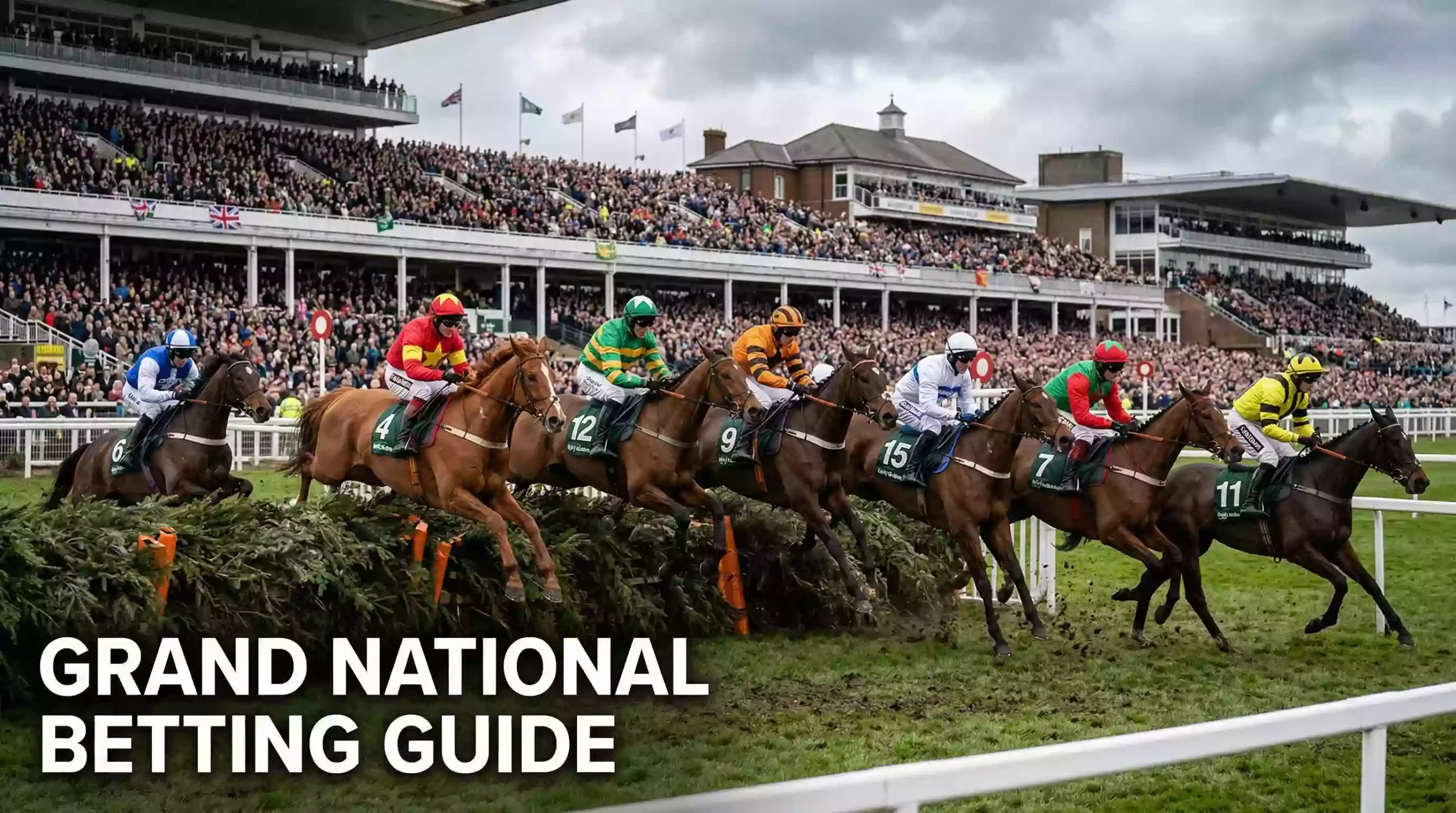
Grand National betting is unlike anything else in the British racing calendar. The race at Aintree draws in millions of people who never place a bet at any other time of year — office sweepstakes, family accumulators, the once-a-year flutter that has become as much a part of spring as the clocks going forward. In 2025, the entire Aintree Festival generated betting turnover exceeding £250 million, with roughly £200 million of that concentrated on the Grand National itself. By comparison, industry data showed that the Grand National attracted 700% more bets than the Cheltenham Gold Cup in 2024. No single race in British sport commands that kind of wagering attention. Grand National Betting Guide — More on this topic at horse racing bookmakers.
That volume creates a peculiar market dynamic. On one hand, bookmakers are desperate for Grand National customers — the race is their biggest acquisition event of the year, and the promotions reflect it. On the other hand, the sheer number of runners, the unpredictability of the course, and the massive casual-punter participation mean that bookmaker margins on the Grand National are wider than on almost any other race. The nation’s punt is also, quietly, the bookmaker’s best day of the year.
This guide is designed to help you navigate that tension. Whether you are a first-time bettor picking a horse because you like the name or an experienced punter looking for structural edges in a large-field handicap, the principles are the same: understand the numbers, choose the right bookmaker for the bet you want to place, and know where the hidden costs sit. The Grand National rewards preparation — even if the race itself rewards chaos.
What follows covers the financial scale of the race and what it reveals about the market, a comparison of bookmaker offers tailored to the specific demands of a large-field handicap, the mathematics of each-way betting when the field is far larger than a normal race, and the safety issues that arise when a once-a-year betting event attracts operators who operate outside the law. Grand National day is a spectacle. But it is also a market — and markets reward those who come prepared.
Grand National in Numbers
The Grand National’s scale sets it apart from every other race in the calendar. The £250 million turnover figure from 2025 tells only part of the story. What makes the Grand National unique is not just how much is bet, but who is betting. Around half of the total turnover comes from stakes of £5 or less, according to industry data from the Aintree Festival — the loose change of casual punters rather than the calculated positions of regulars. That ratio does not exist in any other race. Cheltenham skews toward experienced bettors; the Derby attracts a broader audience but nothing approaching the Grand National’s penetration into the general public.
Operator figures also reveal that approximately 30% of Grand National bettors were either making their first ever deposit or their first bet in over a year. That is an extraordinary re-engagement rate. It means the Grand National functions as the betting industry’s annual open door — the one event that brings lapsed and entirely new customers into the fold. Bookmakers price their promotions accordingly, and if you understand that dynamic, you can find value in the generosity.
Grainne Hurst, CEO of the Betting and Gaming Council, described the race as “one of the precious few sporting events in this country with the ability to unite the entire nation around a single spectacle” — the nation’s punt, in her words. That cultural status is precisely what makes the Grand National attractive to legitimate bookmakers and dangerous for punters who stray outside the regulated market.
The shadow side of all this money is the black market. The BGC estimated that around £9.4 million of the Grand National’s 2025 turnover — roughly 3.8% of the total — was wagered through unlicensed operators. That figure might sound small in percentage terms, but it represents real punters placing real bets with operators who have no obligation to pay out, no fund protection, and no regulatory oversight. The Grand National’s appeal to casual, first-time bettors makes it a prime target for unlicensed sites that mimic legitimate platforms and offer superficially attractive odds. We will return to this problem in the safety section below.
One more number worth noting: the Grand National currently has a maximum of 34 runners, reduced from 40 in 2024 as part of a series of safety reforms at Aintree. That is still roughly four times the average field size in British jump racing. A 34-runner handicap over four miles and two furlongs with 30 fences is the most chaotic betting proposition in the sport, and the bookmaker’s overround reflects it. Where a standard eight-runner hurdle might carry a margin of 115–120%, the Grand National’s day-of-race market typically runs wider, and the ante-post market wider still. Understanding what you are paying for that chaos is the starting point for any sensible Grand National strategy.
How to Choose a Bookmaker for the Grand National
Every major bookmaker wants your Grand National business, which means the promotions during Aintree week are among the most aggressive of the year. But not all offers are equal, and the right operator for the Grand National depends on the type of bet you plan to place. Rather than chasing a familiar name, focus on the criteria that match your betting style.
For each-way bettors — and each way is by far the most popular Grand National bet type — the critical variable is place terms. Standard each-way terms on a large-field handicap pay out on the first four places at one-quarter the odds. But several bookmakers extend their terms for the Grand National specifically, paying five, six, or even seven places. That extension changes the economics of each-way betting dramatically. In a field of up to 34 runners — the maximum since Aintree reduced the cap from 40 in 2024 for safety reasons — a horse finishing fifth or sixth is not a freak result — it is a highly plausible outcome, and getting paid for it rather than losing your entire stake shifts the expected value of the bet materially in your favour.
The first criterion is extra-place depth. Some operators extend to six places as standard on the Grand National for funded accounts, occasionally seven. If a bookmaker also applies Best Odds Guaranteed, you get a combination that is hard to beat for this specific race — you lock in an early price, the BOG floor protects you if the SP drifts wider, and the extra places widen the safety net. For a race where prices can move significantly between morning and post time, that pairing of extra places and BOG should be your baseline requirement.
The second criterion is downside protection. Look for money-back specials — refunds if your horse falls at the last, or a free bet returned if your selection finishes second or third. These promotions are genuinely useful in a race where fallers and near-misses are common, and the refund typically comes as a free bet usable on any subsequent race. For casual bettors who want insurance against the inherent unpredictability of the Grand National, this type of offer has real practical value.
The third criterion is ante-post market breadth. If you want to back a horse for the Grand National months in advance, check which operators price up more runners earlier. A wider ante-post book means more choice and — occasionally — better value before the market tightens. Some bookmakers also run enhanced-odds specials on selected ante-post runners, though these are heavily capped at a maximum stake of £1 to £5, adding a small sweetener rather than a strategic advantage.
The fourth criterion is app quality and onboarding ease. If you are new to betting and the Grand National is your entry point, prioritise operators with a clean interface, straightforward welcome offers, and responsive customer service during Aintree week. A smooth onboarding experience matters when millions of first-time users are flooding in at the same time. Experienced punters will care less about the app and more about odds sharpness — and the two do not always go together.
The fifth criterion is flexibility in bet construction. Some operators offer bet-builder or request-a-bet features that let you combine Grand National selections with other Aintree races or even cross-sport events. For punters who treat the Grand National as entertainment rather than investment, this flexibility in constructing novelty multiples adds to the experience. The trade-off is that operators strong on customisation features sometimes offer less generous standard each-way terms, so weigh the fun factor against the raw value.
The bottom line for the Grand National is that your bookmaker choice should follow your bet type. Each-way punters should prioritise extra places. Casual once-a-year bettors should prioritise clean welcome offers and money-back insurance. And serious punters who bet ante-post should check which operator has the widest market and the lowest early overround.
Each Way Strategy for Big-Field Handicaps
Each way is the default Grand National bet, and for good reason. In a race with up to 34 runners over the most demanding course in the country, backing a horse to win outright is a high-variance proposition. Each way splits your stake in two: half on the win, half on the place. If your horse wins, both parts pay out. If it finishes in the places — typically the first four, though extended terms push that to five, six, or seven — you collect on the place portion at a fraction of the win odds, usually one-quarter.
The mathematics of each way on the Grand National are distinctive. Consider a horse priced at 20/1. A £10 each-way bet costs £20 total — £10 on the win at 20/1, and £10 on the place at 5/1 (one-quarter of 20/1). If the horse wins, you collect £210 on the win part plus £60 on the place part, for a total return of £270 on a £20 stake. If it finishes in the places but does not win, you collect £60 on the place part only, meaning you have spent £20 and recovered £60 — a net profit of £40. That place profit is what makes each way attractive in a race with so many runners: you do not need the horse to win to make money.
Where the strategy becomes interesting is with extra places. If your bookmaker is paying six places instead of four, the probability of your horse finishing in the money increases significantly. In a 34-runner field, the difference between four-place and six-place terms is not marginal — it is roughly a 50% increase in the likelihood of collecting on the place portion. Over time, that edge compounds. For a race you bet on once a year, it might not matter in isolation. But if you are placing multiple each-way bets across the Grand National card and the wider Aintree Festival, those extra places add up.
The trap with each way on the Grand National is betting at short prices. A horse at 5/1 each way costs the same £20, but the place return at 5/4 is only £22.50 — barely more than your stake. At that price, you are paying full exposure for a result that gives you almost nothing back unless the horse wins. Each way on the Grand National is most valuable at odds of 12/1 or longer, where the place return alone comfortably exceeds your total stake. That is the sweet spot where you are being paid enough for the place to justify the overall outlay.
Another angle worth considering is each-way doubles and trebles across the Aintree card. If you fancy a horse in the 2.20 and another in the Grand National at 4.15, an each-way double gives you the multiplied odds on the win and a place double at the fractional terms. The mathematics are more complex, but the principle is the same: in large-field races with volatile outcomes, being paid for places as well as wins shifts the probability distribution in your favour.
One caution: the bookmaker’s margin on Grand National each-way markets is higher than on standard races, because the place fraction is calculated from the win overround, which is itself inflated by the large field. You are not getting a free lunch with each way — you are simply choosing a bet structure that better suits the extreme conditions of this particular race. Combined with extra-place offers, that structure can deliver genuine value. Without extra places, the maths still work at longer odds, but the margin you are fighting against is steeper.
Staying Safe: Licensed vs Unlicensed Operators
The Grand National’s reach into the casual betting market makes it the single most targeted event for unlicensed gambling operators in the UK. According to the International Federation of Horseracing Authorities, unique visitors to unlicensed betting sites in the UK grew by 522% between August 2021 and September 2024. Over the same period, traffic to licensed sites grew by just 49%. That disparity is alarming, and the Grand National is where it is most visible.
The IFHA’s research identified around 600,000 unique British visitors to unlicensed betting platforms in the first nine months of 2024. These are not back-alley operations — they are polished websites that mimic the look and feel of licensed bookmakers, offer competitive odds, and accept deposits through standard payment methods. For a first-time bettor searching “Grand National odds” on their phone, distinguishing a licensed operator from an unlicensed one is not always obvious.
The risks of using an unlicensed site are straightforward and severe. There is no UK Gambling Commission oversight, which means no obligation to pay out winning bets, no segregation of customer funds, no responsible gambling tools, and no recourse to the alternative dispute resolution process that UKGC licensees are required to provide. If an unlicensed operator decides not to pay your Grand National winnings, there is nothing you can do about it. Your money has no legal protection.
Checking whether a bookmaker is licensed is simple. Every UKGC-licensed operator is required to display their licence number on their website, usually in the footer. You can verify this number on the Gambling Commission’s public register at gamblingcommission.gov.uk. If a site does not display a licence number, or if the number does not appear in the register, do not deposit. The extra few minutes it takes to verify a licence could save you every penny of your Grand National stake.
The growth of unlicensed operators is driven by several factors — regulatory costs, tax increases, and the perception among some punters that unlicensed sites offer fewer restrictions. But the trade-off is entirely one-sided. Licensed bookmakers operate under rules designed to protect your money and your wellbeing. Unlicensed ones operate under no rules at all. On Grand National day, when millions of occasional bettors enter the market, that distinction could not be more important.
There are practical steps beyond licence verification that protect you further. Use a debit card rather than cryptocurrency or bank transfer when depositing, because card payments are covered by chargeback protections that other methods are not. Set a deposit limit before Grand National week — every UKGC-licensed bookmaker is required to offer this tool, and it takes thirty seconds to activate. And if you receive an unsolicited message promoting Grand National odds from a site you have never heard of, treat it as a red flag. Legitimate bookmakers do not cold-contact potential customers through text messages or social media direct messages with betting offers. That approach is almost exclusively the domain of unlicensed operators fishing for Grand National traffic.
Smart Betting on Grand National Day
The Grand National is the one race where almost every type of bettor is in the market at the same time, and the smart approach depends entirely on which type you are. The race does not change to suit your strategy — you have to suit your strategy to the race.
If you are a casual punter betting on the Grand National for the fun of it, simplicity is your friend. Pick one or two horses, back them each way at the best price you can find with a bookmaker offering extended place terms, and enjoy the race. Your total stake should be an amount you would happily spend on an afternoon’s entertainment and never think about again. A welcome offer from any major licensed bookmaker will offset some of your outlay, and money-back specials provide insurance against the most frustrating outcomes. Do not overthink it. The Grand National is supposed to be fun, and a £5 each-way bet at 25/1 gives you a genuine rooting interest without any financial risk worth worrying about.
If you are an experienced bettor looking for value, the Grand National is a different proposition. The large field means the market is inherently inefficient — there are more runners than the average bookmaker can price accurately, and the casual money flooding in distorts the odds on well-known names while leaving less fashionable runners underpriced. Look for horses at 20/1 or longer that have the right profile for the race: proven stamina, experience over fences, a weight in the mid-range of the handicap, and ideally previous form at Aintree or over similar distances. The each-way value at these prices, especially with extra-place terms, is where the Grand National’s betting economics favour the punter.
If you are an accumulator player, tread carefully. The temptation to include the Grand National in a multi-race accumulator is strong, but a large-field race with a completion rate that varies wildly from year to year is the worst possible leg to add to an accumulator. If you must include it, keep the Grand National as a standalone each-way bet and build your accumulators from the supporting Aintree races, where fields are smaller and outcomes more predictable. See also Horse Racing Bet Types Explained.
One final point: do not wait until the last minute. Grand National odds tighten significantly in the final hour before the race as casual money pours in. If you have done your research and identified your selections, placing your bet in the morning — when Best Odds Guaranteed protects your price against any subsequent drift — gives you the best available terms. The nation’s punt rewards those who punch their ticket early and watch the race knowing the work is already done.
