

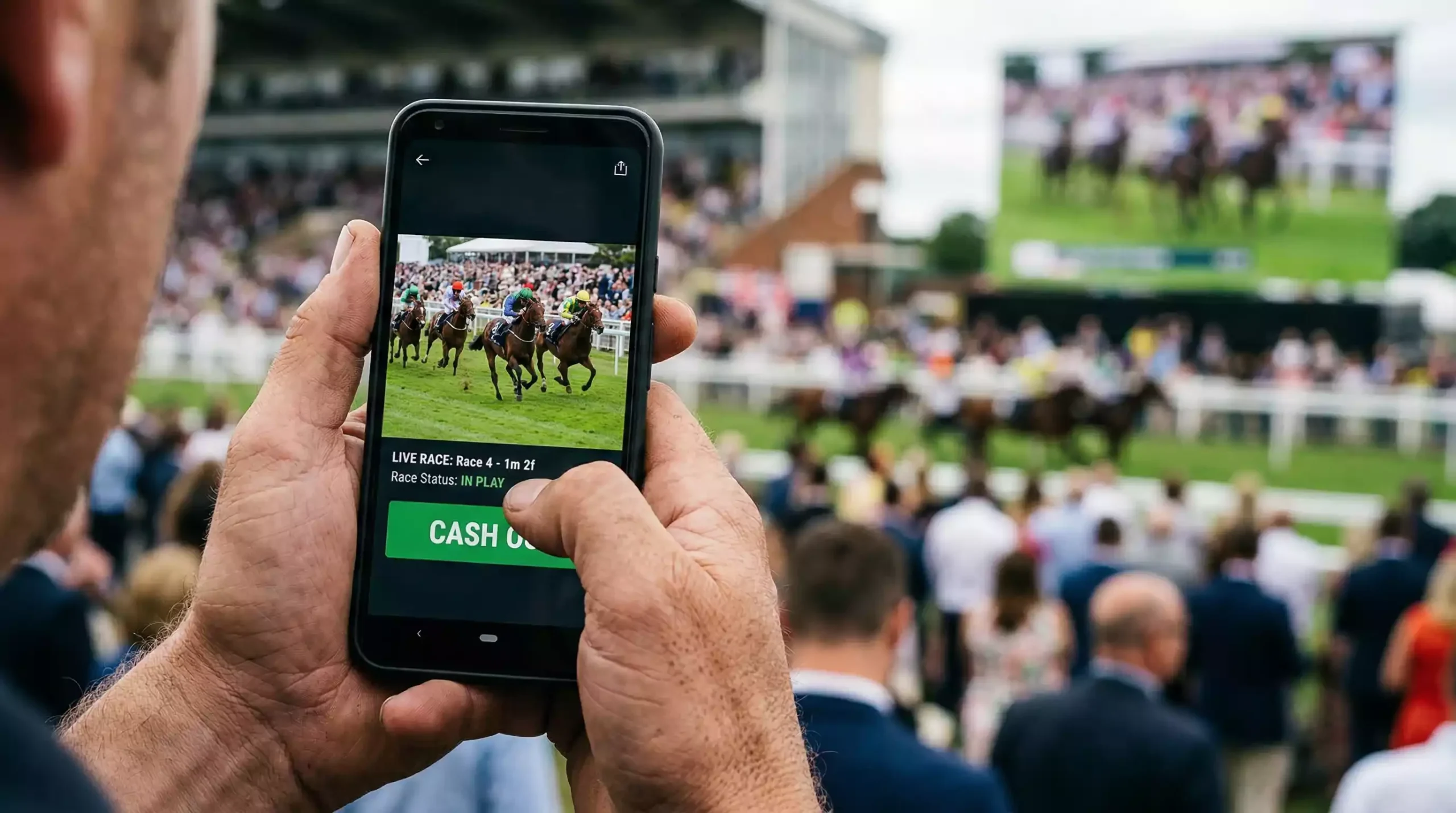
Cash out on horse racing has become one of the most used — and most misunderstood — features in modern betting. The button sits there on your betslip, flashing a number that changes in real time, offering you the chance to take money now rather than wait for the race to finish. It feels like control. It looks like a smart move. And sometimes it is. But the cash out price is not a neutral offer — it is a product, designed by the bookmaker, with a margin built into every number it displays. Cash Out on Horse Racing — More on this topic at horse racing bookmakers.
Understanding when cash out genuinely serves your interests and when it is the bookmaker profiting from your anxiety is essential if you are going to use the feature at all. The broader betting market is changing too: total betting turnover on horse racing across the first nine months of 2025 was 4.2% lower than in 2024 and 12.8% below 2023. As margins tighten, bookmakers are leaning harder on features like cash out to generate additional revenue. Cash out feels like control — make sure the numbers agree.
Cash Out Types: Full, Partial, Auto
Full cash out is the simplest version. You have a live bet, the bookmaker offers you a price to settle it early, and if you accept, the bet is closed. You receive the cash out amount immediately, regardless of what happens in the race. If your horse was leading and you cashed out, then it goes on to win — tough luck. If it was leading and then falls at the last — smart move. Full cash out is a binary decision: take the money or leave the bet running.
Partial cash out lets you take some of the value off the table while leaving a portion of the bet active. If the full cash out offer is £50 and you take 60% of it, you receive £30 immediately and the remaining 40% of the bet continues to run. If the horse wins, you collect on the remaining portion at the original odds. If it loses, you keep the £30 you already took. Partial cash out is the more nuanced tool — it lets you lock in a guaranteed minimum return while retaining exposure to the full result.
Auto cash out sets a threshold. You tell the bookmaker: if the cash out value reaches a certain amount, cash out automatically. This is useful when you cannot watch a race live. If you have backed a horse ante-post and its price has shortened dramatically, you might set an auto cash out at a level that guarantees a profit. If the value reaches that threshold during trading, the bet is settled automatically. The risk is that the value might exceed your threshold and you miss out on a bigger return — but that is the trade-off for automation.
Not all bet types are eligible for cash out. Singles and accumulators on standard win markets are typically covered. Each way bets, forecast bets, and some promotional bets may not be eligible. Availability can also be suspended during a race or in the minutes immediately before the off, when the market is most volatile. Check whether your bet qualifies for cash out at the point of placing, not after the race has started.
The Hidden Margin in Cash Out
The cash out price is not the fair value of your bet. It is the fair value minus a margin. The bookmaker calculates what your bet is worth based on the current odds — essentially, what it would cost to replicate the bet at the live market price — and then applies a discount. That discount is the cash out margin, and it typically ranges from 3% to 10% of the bet’s theoretical value, depending on the bookmaker and the market conditions.
Here is a practical example. You back a horse at 10/1 for £10, giving you a potential return of £110. Before the race, the horse’s price shortens to 4/1, meaning the market now considers it far more likely to win. The fair value of your bet — calculated as your original odds divided by the current odds, multiplied by your stake — is roughly £27.50. The cash out offer might be £24 or £25. The difference between the fair value and the offered price is the bookmaker’s margin on the cash out.
That margin is how the bookmaker profits from the feature. Every time a punter cashes out, the bookmaker pockets the spread between the fair value and the price offered. Across millions of cash out transactions, this generates significant revenue — and it is revenue that comes on top of the overround already built into the original odds. The standard bookmaker overround on horse racing sits between 110% and 130%; the cash out margin adds another layer on top.
This does not mean you should never cash out. It means you should recognise that every cash out you accept leaves money on the table relative to the true value of your position. Sometimes leaving that money is the right call — guaranteeing a profit or cutting a loss has its own value. But doing it reflexively, without understanding what you are giving up, is a reliable way to erode your returns over time.
When to Cash Out (and When Not To)
Cash out makes sense in a limited set of circumstances. The first is when the risk-reward has shifted dramatically. If you backed a 20/1 shot and it is now trading at 3/1 approaching the final furlong, the cash out represents a guaranteed return on a bet that was speculative. Taking that profit is rational, because the horse could still be beaten and you would go from a large potential win to nothing. Locking in a meaningful return on a longshot that has shortened dramatically is the strongest use case for cash out.
The second is on accumulators where all but one leg have won. You have a four-fold with three winners and the final race approaching. The cash out offers a guaranteed profit. Leaving it running risks everything on a single race. For most punters, taking the cash out here — or at least a partial cash out — is the disciplined choice, because the full four-fold payout requires everything to go right and the cash out already represents a strong return.
Cash out makes less sense when the margin erodes most of the value. If you backed a horse at 5/1 and it has shortened to 7/2, the cash out on a £10 bet might be £13 — a £3 profit on a bet that could return £60. The horse is more likely to win now than when you backed it, and the cash out is offering a trivial return relative to the potential. In this scenario, letting the bet run is usually the better decision unless you have reason to believe the horse’s chances have changed for the worse despite the market move.
The emotional trap is cashing out too early on winners and too late on losers. Punters tend to grab small profits quickly (fear of loss) and hold losing positions too long (hope of recovery). Both tendencies are irrational. If cash out is going to be part of your betting, establish rules in advance: at what percentage profit do you consider cashing out, and at what point do you accept a loss? Remove the in-the-moment decision-making and let the rules decide.
What to Look for in Cash Out
The best cash out implementations share three qualities: speed, breadth, and partial cash out support. The leading operators process cash out requests near-instantly, offer the feature on most racing singles and multiples, and allow partial cash out so you can hedge without closing the entire position. The cash out margins at these operators are competitive — not the lowest in the market, but the speed and reliability compensate. For punters who use cash out regularly, execution speed is the benchmark that matters most.
Some operators offer a clean cash out experience with additional features like edit bet functionality, which lets you add selections to an existing bet or change your stake without fully cashing out and re-placing. Exchange platforms offer a manual alternative — laying your selection in-running to lock in profit, which achieves the same economic outcome as cash out but without the bookmaker’s margin built in.
Other operators offer reliable cash out on racing with auto cash out support, which suits punters who want to set a profit target without monitoring every race. Heritage racing bookmakers provide functional cash out but can be slower to refresh during volatile in-play moments, which is a frustration on fast-paced races where seconds matter. See also UKGC Licensed Bookmakers.
The practical advice: if cash out is important to your betting style, prioritise bookmakers with fast processing and partial cash out. And remember that every cash out you accept includes a margin you are paying. Use it strategically and sparingly, not as a default response to every price movement.
